
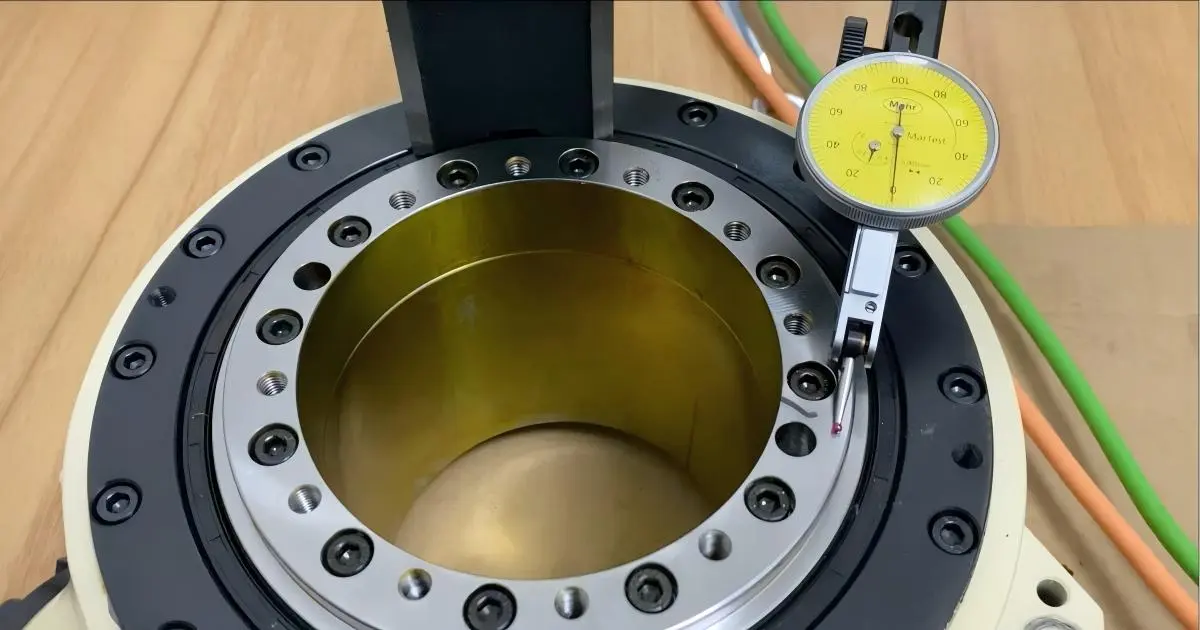
A dial indicator shows how much a rotary table’s reference surface moves during rotation. It does not tell you whether the table stops at the correct angle.
This distinction matters when investigating an accuracy problem. Excessive runout calls for checks of the reference surface, mounting and bearing support. Angular positioning errors also require checks of the encoder, drive and control system.
Axial and Radial Runout
Runout is the variation measured at a reference surface as the table rotates. It is usually reported in micrometres, with the measurement location and test conditions specified.
For axial runout, the indicator measures displacement parallel to the rotation axis, typically on the table face. For radial runout, it measures displacement perpendicular to the axis, typically on a locating bore or cylindrical reference surface.
The reading reflects more than bearing accuracy. Surface form errors, mounting misalignment and assembly deformation can all contribute. A damaged locating surface, for example, can produce a poor reading even when the bearing support is sound.
For table-face measurements, record the distance from the rotation axis. Angular wobble produces greater displacement farther from the centre, so readings taken at different radii are not directly comparable.
Indexing Accuracy Is Not Repeatability
Indexing accuracy describes how closely the actual angular position matches the commanded position. Repeatability describes how consistently the table returns to that target over repeated moves. Both are commonly reported in angular units such as arcseconds.
A table may repeatedly stop at nearly the same angle but remain offset from the commanded position. Its repeatability can be good while its indexing accuracy is poor.
Approach direction matters, too. A table may return consistently when approaching from one direction, yet stop at a different position when approaching from the opposite direction. Backlash or hysteresis may be involved.
When comparing specifications, check whether the results are unidirectional or bidirectional and whether the same test method was used. A single positioning move does not establish either accuracy across the operating range or repeatability.
Where the Bearing Makes a Difference
The bearing supports the rotating assembly. Its running accuracy, stiffness and friction affect how the table moves and responds to load.
Depending on the design, YRT turntable bearings or crossed roller bearings can provide support for combined axial, radial and tilting-moment loads. The selection must also account for speed, installation space and mounting conditions.
Bearing running accuracy is not an assembled-table accuracy specification. A precision bearing cannot compensate for a distorted mounting face. Nor can it directly correct encoder calibration errors, gear backlash or unsuitable servo settings.
This is why a bearing upgrade should follow diagnosis rather than replace it. For load and arrangement considerations, see our rotary table bearing selection guide.
Start with the Error You Can Measure
If the Runout Reading Is High
First, confirm that the reading is reliable. Use a rigid indicator setup, check the contact direction and inspect the reference surface for dirt or damage.
- Measure at a defined location and repeat the check under consistent conditions.
- Inspect mounting faces, alignment and fastening against the assembly requirements.
- Check for bearing damage, abnormal clearance or deformation of the housing and table.
- Note whether the reading changes with load or operating temperature.
A high reading alone does not prove bearing failure. Separate reference-surface errors from support-related motion before deciding what to replace.
If the Table Stops at the Wrong Angle
Use a suitable independent angular measurement method to verify the actual position. A runout check with a dial indicator is not enough.
- Compare positioning results when approaching from both directions.
- Check the encoder installation, feedback arrangement and compensation data.
- Review the drive mechanism and control settings.
- Compare cold and warmed-up operation, with the load conditions recorded.
A direct-drive table removes gear transmission errors, but it still depends on encoder quality, control tuning and thermal stability. Mechanical support remains part of the assessment.
Before Replacing the Bearing
Provide the full bearing designation and an assembly drawing, along with the measured problem. “Poor accuracy” is too broad to guide a replacement review.
For runout, include the reference surface, measurement radius and readings. For angular positioning, include the test method, approach directions and repeated results. In both cases, record the load and temperature conditions.
Visit TEDIN rotary table bearings to discuss the bearing support requirements. Replacing the bearing may address a confirmed support problem; an encoder or drive error requires a different remedy.