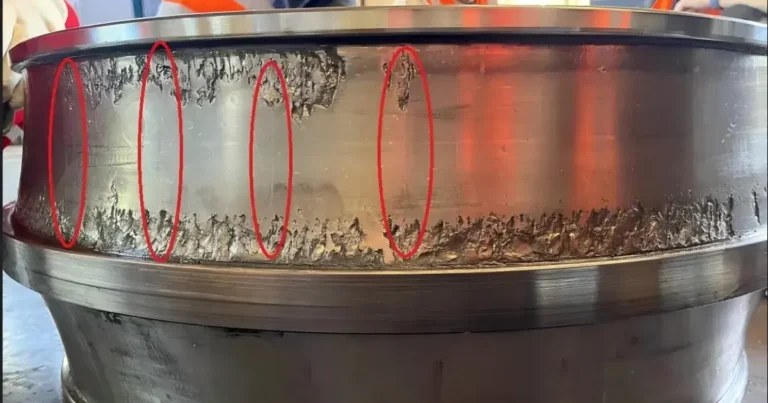
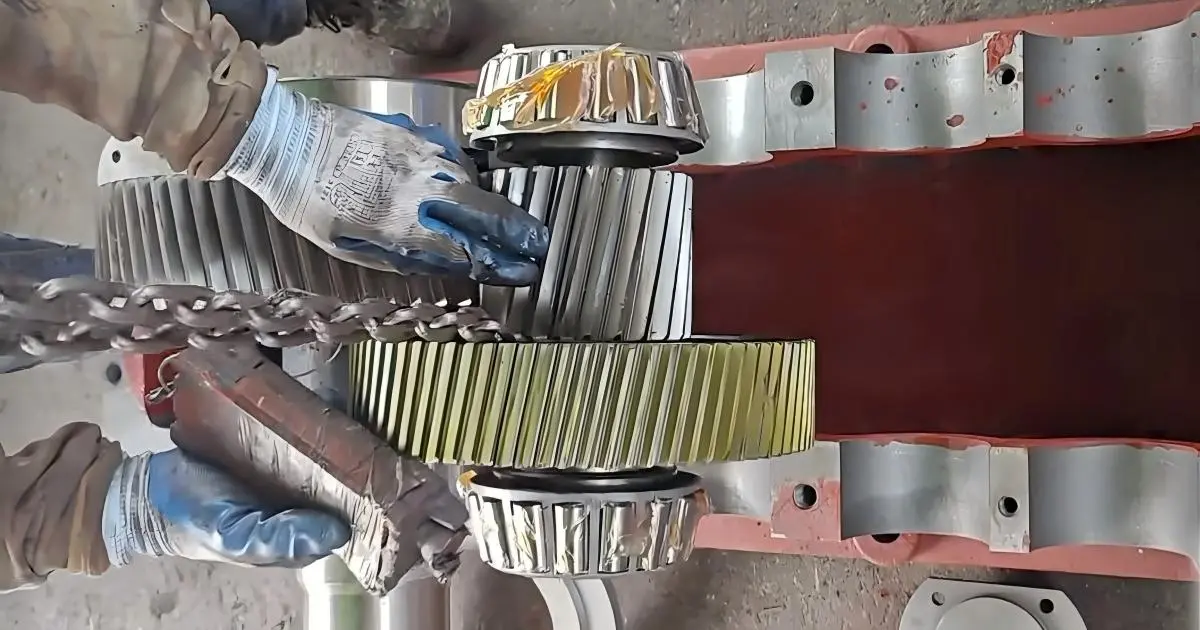
A gearbox shaft asks two things of its bearings: carry the gear forces, and hold the shaft in the right axial position while doing it. Most selection mistakes come from handling only the first. A bearing with plenty of radial capacity can still be the wrong choice if it leaves the shaft free to wander, or if it locks the shaft at both ends and leaves no room for thermal growth.
This guide works from the shaft outward: what the gears push on, which end locates the shaft, and which bearing type suits each position. It is written for engineers and buyers who are choosing bearings for a new gearbox or checking a replacement against the original arrangement. Where a value depends on the gearbox design, it is left to the gearbox manufacturer’s documentation.
Select gearbox bearings in this order:
- Gear type: spur, helical, bevel and worm gears load the shaft differently.
- Shaft position: input, intermediate or output shaft, and which end locates the shaft.
- Load direction: radial only, or radial plus axial in one or both directions.
- Bearing type: tapered, cylindrical, spherical, angular contact or thrust, depending on the first three.
- Operating data: speed of that shaft, lubrication method, temperature, shock and starting duty.
For a replacement, start from the original arrangement and the removed bearing. Matching bore, outside diameter and width is not enough.
What Forces Do the Gears Put on the Bearings?
Every gear mesh produces a tangential force, which carries the torque, and a separating force that pushes the gears apart. Both load the bearings radially. Helical, bevel and worm gears add an axial force on top of that.
| Gear type | Forces on the shaft | What it means for bearings |
|---|---|---|
| Spur | Tangential and radial; no axial force from the mesh | Radial loads, but the shaft still needs axial location |
| Helical | Radial plus axial thrust that reverses with rotation | Locating bearing must suit the running direction(s) |
| Bevel | Radial plus axial, set by gear geometry and rotation | Overhung pinions load the nearer bearing harder |
| Worm | High axial force on the worm; sliding contact adds heat | Axial capacity and temperature need separate review |
Gear force is not the same as bearing load. The reaction at each bearing depends on where the gear sits between the supports. A gear mounted between two bearings shares its load across them. An overhung gear, common on some pinion shafts, loads the closer bearing much more heavily. Work out the reaction at each position, using the gearbox manufacturer’s data where you have it.
Direction matters as much as size. On a helical gear shaft in a gearbox that runs both ways, the axial thrust changes direction when rotation reverses. A locating bearing chosen for one direction only will cope until the first reversal.
Which Bearing Locates the Shaft and Which One Floats?
On most shafts, one end (the fixed or locating side) holds the shaft axially. The other end (the floating or non-locating side) lets the shaft move a little as it warms up and to absorb machining tolerances. If both ends are locked, temperature rise can load the bearings axially in ways nobody designed for. If neither end locates the shaft, the gear contact pattern drifts.
Two layouts turn up often. They are shown to explain the logic, not as a recommendation for any particular gearbox:
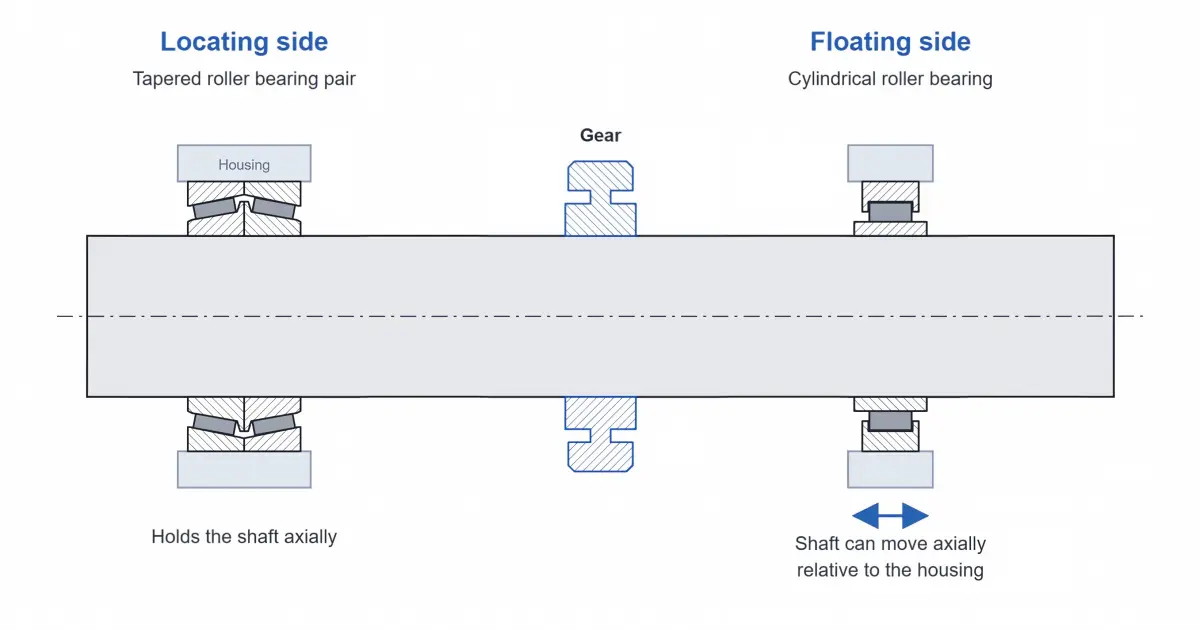
- A tapered roller bearing pair on each shaft, adjusted to a set end float or preload. The pair locates the shaft and takes radial and axial load together.
- A cylindrical roller bearing on the floating side, with a locating bearing or bearing set at the other end.
Which one applies depends on the gear forces, the housing and the maker’s design. When replacing, keep the original layout unless there is a reason to change it, and review the change as a whole assembly.
Which Bearing Type Suits Which Position?
The table lists typical uses. Suitability for a specific position must be confirmed against the exact bearing design and the gearbox arrangement.
| Bearing type | Typical position | Load function | Check |
|---|---|---|---|
| Tapered roller | Output, pinion and bevel shafts, usually in pairs | Radial and axial; each bearing takes axial load one way | Pair layout and axial setting |
| Cylindrical roller | High radial load positions, floating side | Heavy radial; axial depends on the rib design | Design code and clearance |
| Spherical roller | Heavy-duty shafts with deflection or housing deformation | Heavy radial, some axial both ways, tolerates misalignment | Fits, clearance, bore type, minimum load |
| Angular contact ball | High-speed shafts, locating positions | Radial and axial; paired for both directions | Pair layout, contact angle, preload |
| Thrust roller | Vertical and worm gearboxes | Axial, one or both directions by design | Load direction, alignment, lubrication |
Tapered roller bearings
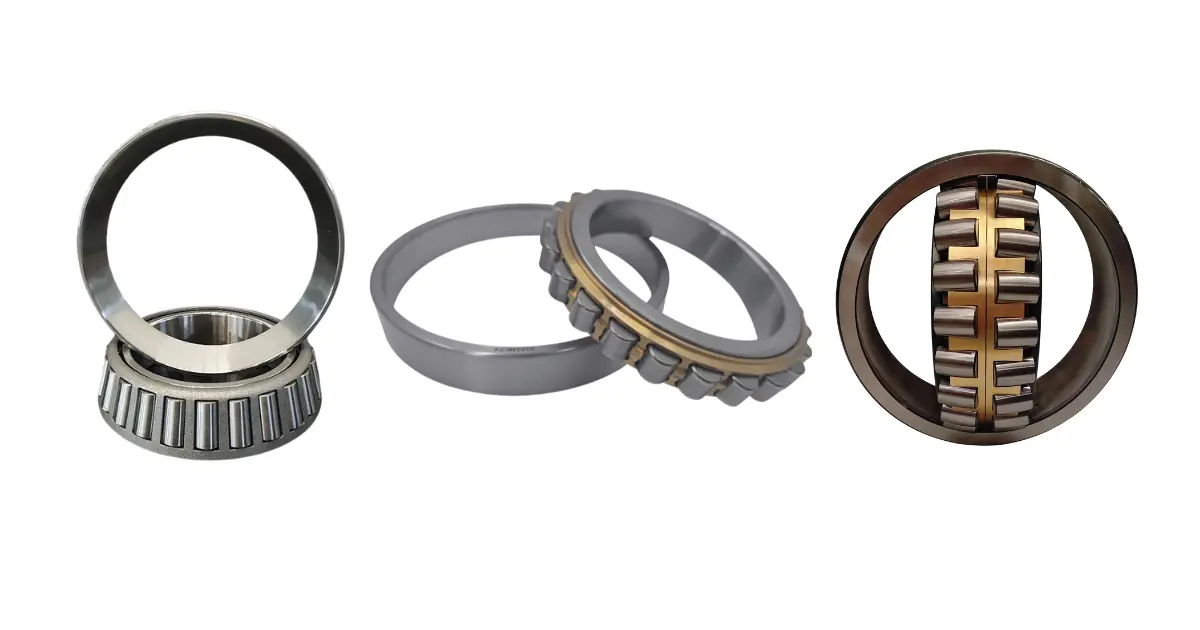
Tapered roller bearings carry radial and axial load together. A single bearing takes axial load in one direction only, and any radial load on it creates an axial component, so they are normally mounted in opposing pairs. The pair locates the shaft, and the axial setting is adjusted at assembly with shims, a nut or a spacer. The setting value belongs to the gearbox manufacturer. What goes wrong when it is too tight or too loose is covered in the gearbox bearing failure guide.
Cylindrical roller bearings
Cylindrical roller bearings give high radial capacity in a compact section. The design code tells you what they do axially. N and NU types have no ribs on one ring, so the shaft can move axially relative to the housing, which suits the floating side. NJ types guide the shaft in one direction and NUP types in both, but the ribs carry limited axial load. Do not treat them as thrust bearings. Check the permitted axial load for the exact design, speed and lubrication.
When a spherical roller bearing makes sense
Spherical roller bearings are worth considering when the shaft deflects noticeably or the housing deforms under load, so the rings no longer stay aligned. They accept some misalignment, but not every alignment fault. Check the shaft and housing geometry first. In a floating position the design must let one ring move axially, which the housing fit has to allow. Confirm whether the shaft needs a cylindrical or tapered bore, and remember that roller bearings need a minimum load to roll properly.
Angular contact ball and thrust bearings
Angular contact ball bearings are used where axial location and running accuracy matter at higher speed, usually in pairs. Thrust roller bearings carry axial load on vertical and worm gearboxes. Both depend heavily on the exact design, so verify load direction, alignment and lubrication against the original specification.
How Do Speed and Heat Affect the Choice?
Use the speed of the shaft the bearing sits on. In a speed reducer the input shaft is normally the fastest. In a speed increaser it is the output shaft. Do not assume which one is which.
Catalogue speed figures need to be read with their definitions. Reference speed and limiting speed are different things, and the usable speed depends on load, cage design, internal clearance and how the oil reaches the bearing. Oil bath, splash and circulating systems behave differently. In an enclosed gearbox, check the real operating temperature as well, because temperature shifts clearance and oil viscosity. The lubrication-side causes of heat are discussed in crusher bearing overheating, and the same logic applies to gearboxes.
What About Shock Loads, Starts and Reversing?
Rated power describes normal running, not the peaks. Starts under load, braking, reversing and process shocks can push torque well above the running value. Include peak torque, and how often it happens, in the duty cycle. If the gearbox manufacturer has a load spectrum, use it.
Typical places where this matters include gearboxes behind jaw crushers and cone crushers, mining conveyor drives, cranes and mill drives. Roll neck bearings are a separate problem; see rolling mill bearing selection.
The opposite problem exists too. A lightly loaded roller bearing in a large bearing size can slide instead of roll, which leaves smeared surfaces. Rated capacity alone does not tell you whether the bearing is correctly sized.
What Should You Check Before Replacing a Gearbox Bearing?
- Record every marking. Write down the full designation, including suffixes, from the removed bearing.
- Photograph the arrangement first. Capture bearing orientation, which side locates, spacers, shims, covers and seals before anything is pulled.
- Keep matched parts together. Cups, cones and paired bearings should not be mixed unless compatibility is confirmed.
- Measure the seats. Check shaft journals and housing bores against the drawing. Do not assume they are within tolerance.
- Hold the original layout. Swapping an NU for an NJ, or a tapered pair for a cylindrical bearing plus a thrust bearing, changes axial guidance, fits and setting.
- Read the damage. Spalling, dents, smearing and fretting point to different causes. See the failure guide before ordering.
- Use the maker’s setting. Do not copy the old shim pack, because worn seats change the result.
- Clean the housing and check the oil. Debris from the last failure will go straight through the new bearing.
If the replacement comes from a different manufacturer, check what the suffixes mean. Similar codes do not guarantee the same internal clearance, cage, tolerance class or lubrication features.
What Information Is Needed to Confirm a Replacement?
| Information | Why it helps |
|---|---|
| Bearing code and suffixes | Identifies the reference design |
| Photos of the old bearing | Confirms type, cage and condition |
| Gearbox maker, model, nameplate | Links the bearing to the arrangement |
| Shaft position and gear type | Sets load direction |
| Speed of that shaft | Checks the speed range |
| Lubrication method and oil grade | Checks supply and viscosity |
| Operating temperature | Affects clearance and oil |
| Shaft drawing or measured sizes | Confirms fits and space |
Gearbox Bearing Selection FAQ
Can I choose a gearbox bearing from shaft diameter and housing bore alone?
No. Bore, outside diameter and width only give the envelope. Tapered, cylindrical and spherical roller bearings can share the same envelope and still behave differently in axial location, setting and misalignment.
Can a cylindrical roller bearing carry axial load in a gearbox?
It depends on the design. N and NU types carry none and allow axial movement. NJ and NUP types carry limited axial load through their ribs. For sustained axial load, another bearing normally provides the locating function. Check the permitted load for the exact design.
Why are tapered roller bearings often used in pairs on gearbox shafts?
One tapered roller bearing takes axial load in one direction only, and radial load on it creates an axial component. A pair works against each other, locates the shaft and allows the setting to be adjusted. The setting then has to be correct, and it changes with temperature.
Is the input shaft always the high-speed shaft?
No. In a speed reducer it usually is. In a speed increaser the output shaft runs faster. Use the actual speed of the shaft the bearing sits on.
What if there is no gearbox manual for the replacement?
Do not guess the arrangement. Photograph and record the layout, note every marking, measure the shaft and housing, and send the details for review. Treat any proposed replacement as unconfirmed until it is checked against the original assembly.
Request a Gearbox Bearing Review
TEDIN supplies standard replacement and drawing-based gearbox bearings for industrial gearboxes. For an enquiry, send the bearing code, photos of the old bearing, the gearbox model, the shaft position and any shaft drawing or measured dimensions.
Operating speed, lubrication method and temperature help as well. You can send them to info@tedinbearings.com, or through the contact page.