When a machine tool spindle uses a double-row cylindrical roller bearing, the designation often begins with NN or NNU. Both designs provide radial support, but their ring construction differs. That difference affects which components separate during assembly and what needs to be checked before ordering a replacement.
Comparing NN vs. NNU bearings starts with the ribs on the inner and outer rings. Selecting a bearing takes more information: the complete series, bore execution, accuracy, radial internal clearance and the spindle’s axial locating arrangement.
What Is the Difference Between NN and NNU Bearings?
In the usual NN design, the inner ring has three integral ribs, while the outer ring has no ribs. The inner ring retains the roller and cage assembly, and the outer ring can be separated.
In the usual NNU design, the arrangement is reversed. The outer ring has three integral ribs, while the inner ring has no ribs. The outer ring retains the roller and cage assembly, and the inner ring can be separated.
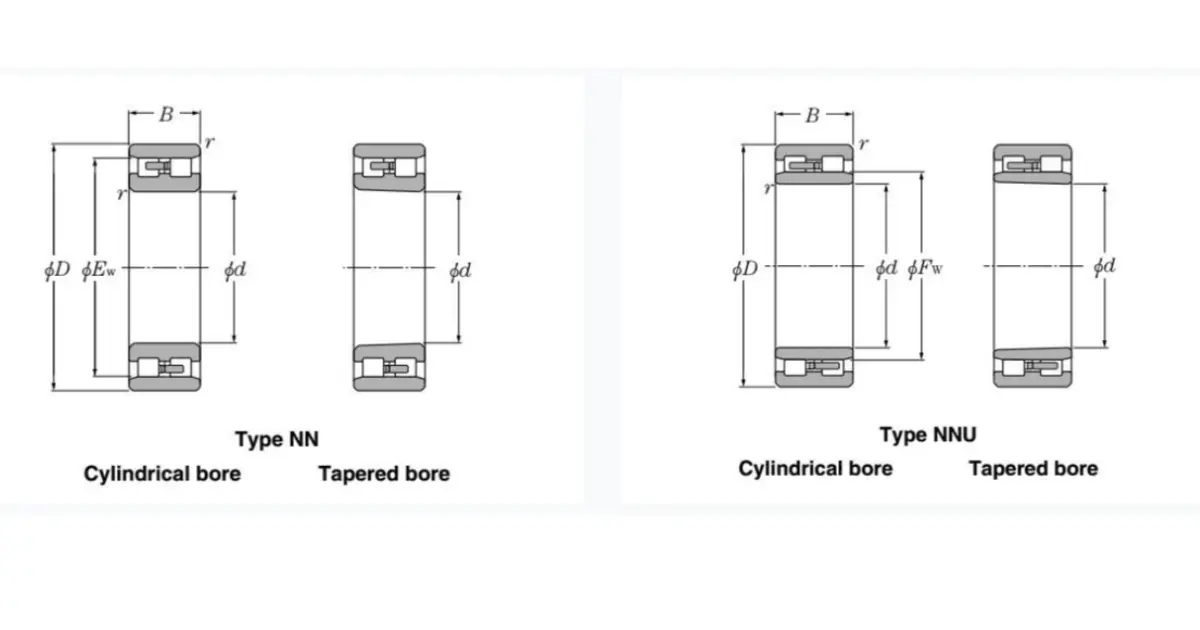
Simplified sections shown; actual designs vary by series.
Both are forms of double-row cylindrical roller bearings. Their two rows of rollers provide radial support, while the ribless ring permits relative axial displacement within the bearing’s specified limits.
| Feature | NN Design | NNU Design |
|---|---|---|
| Inner ring | Three integral ribs | No ribs |
| Outer ring | No ribs | Three integral ribs |
| Roller and cage assembly | Retained on the inner ring | Retained in the outer ring |
| Separable ring | Outer ring | Inner ring |
| Main support role | Radial support | Radial support |
| Relative axial displacement | Permitted within the bearing’s specified limits | Permitted within the bearing’s specified limits |
The ribs guide the rollers. Their presence does not make either design a substitute for a dedicated thrust bearing or an angular contact bearing arrangement that locates the spindle axially.
NN and NNU Identify the Design, Not the Complete Specification
The letters tell you how the rings and rollers are arranged. They do not, by themselves, establish the bearing’s dimensions, load ratings, speed capability, precision or bore type.
For example, NN 30 and NNU 49 are familiar series in precision spindle applications. At a corresponding standard bore size, NN 30 generally has a larger outside diameter and a narrower width than NNU 49. Those proportions come from the dimension series, not simply from the NN or NNU rib arrangement.
This distinction matters when comparing catalogue entries. A statement such as “NN bearings are more rigid” or “NNU bearings carry more load” is too broad to guide a selection. Compare the actual bearing sizes, internal designs, ratings and mounting conditions.
Matching bore diameters alone is not enough. Outside diameter, width, shoulder dimensions and the space available for adjacent components must also agree with the spindle drawing.
How They Work in a Machine Tool Spindle
A spindle bearing system must control radial movement and axial position while allowing for the intended thermal behaviour. Those functions do not necessarily come from the same bearing.
An NN or NNU bearing may provide radial support, while a separate thrust bearing or angular contact bearing arrangement carries axial loads and locates the spindle. Other spindle designs use different combinations, so the complete assembly needs to be considered.
When selecting machine tool spindle bearings, identify the locating and non-locating functions before choosing individual bearings. The ability of an NN or NNU bearing to accommodate internal axial displacement can be useful, but the available movement must suit the assembly.
Do not confuse this internal movement with a loose ring fit. The shaft and housing fits still need to be suitable for the loads, ring rotation, accuracy and installation method.
Does NN or NNU Mean a Tapered Bore?
No. NN and NNU describe the bearing design, not the bore execution. Depending on the series and manufacturer, cylindrical-bore and tapered-bore versions may be available.
A suffix such as K commonly identifies a tapered bore. In many applicable precision cylindrical roller bearing series, this is a 1:12 taper. Confirm the meaning in the manufacturer’s catalogue rather than assuming every tapered bearing uses the same execution.
Cylindrical-Bore Bearings
With a cylindrical bore, shaft and housing fits influence the installed radial clearance. Interference fits can reduce clearance, and operating temperatures can change it further. The required initial clearance therefore depends on more than the bearing’s nominal dimensions.
Tapered-Bore Bearings
A tapered bore allows the inner ring to expand as it is driven up its mating tapered seat, reducing radial internal clearance. This gives a means of adjustment, but it does not remove the need for measurement.
Use the specified mounting procedure and measuring method. A generic axial drive-up distance is not a reliable setting for every bearing size, shaft design or spindle assembly.
Radial Clearance Before Mounting Is Not the Final Setting
A clearance designation describes the bearing under defined conditions before mounting. It is not a direct statement of the clearance that will remain in the assembled spindle.
The installed condition is affected by fits, tapered-seat adjustment where applicable, and the dimensions of the surrounding parts. During operation, differences in temperature between the shaft, rings and housing can alter that condition again.
Some precision spindle designs specify a very small radial clearance or a controlled radial preload. Neither should be adopted as a general target for all NN or NNU bearings. The intended setting belongs to the particular spindle design.
For replacement work, record both the original bearing’s clearance specification and any assembly instructions. If only the basic number is readable, do not assume that a standard-clearance bearing is suitable.
Which Design Should You Choose?
For an existing spindle, start with its drawing and complete original bearing designation. If you are designing a new spindle, compare candidate bearings against the support arrangement, loads, speed, accuracy and mounting space.
Check the Radial Load and Stiffness Requirements
Compare catalogue load ratings and available stiffness data for the actual bearings. Roller geometry, bearing size and installed clearance all matter. For a spindle nose exposed to cutting forces, also consider the distance between supports and the surrounding shaft and housing stiffness.
Check Speed and Lubrication Together
Neither NN nor NNU is automatically the faster choice. Speed suitability depends on the specific bearing design, cage, clearance or preload, lubricant supply and heat removal.
Catalogue speed values also have stated conditions. They should not be treated as an approved spindle speed without checking the complete operating arrangement.
Check the Assembly Sequence
The separable ring can affect how the shaft and housing are assembled. With NN, the outer ring separates from the inner ring and roller assembly. With NNU, the inner ring separates from the outer ring and roller assembly.
Review tool access, bearing seats and adjacent components before deciding that one arrangement is easier to install. In either case, protect the rollers and raceways during assembly and do not mix components from different bearings unless the manufacturer explicitly permits it.
Can an NN Bearing Replace an NNU Bearing?
Not on the basis of a matching bore size. An NN-to-NNU change should be treated as a design review, not a routine part-number substitution.
Before accepting a proposed replacement, confirm:
- Boundary dimensions: bore, outside diameter and width.
- Mounting details: shoulder dimensions, corner clearances and available assembly space.
- Bore execution: cylindrical or tapered, including the specified taper.
- Accuracy: dimensional and running accuracy requirements.
- Internal specification: radial clearance, cage and other design features.
- Operating suitability: loads, speed, lubrication and temperatures.
- Support arrangement: axial locating bearings and required axial displacement.
The same checks apply to cross-brand replacements, even when both bearings use NN or NNU in their designations.
In a complete machine tool bearing system, the radial bearing has to work with the axial bearings and mounting parts. A replacement that fits the seat may still leave the spindle with the wrong running clearance, insufficient stiffness or an unsuitable thermal arrangement.
What to Record Before Ordering
Keep a photograph of the complete marking, including suffixes, together with the measured dimensions and installation position. Record the manufacturer, bore type, accuracy and clearance codes, plus any separate identification marks.
For a tapered-bore bearing, retain the original setting instructions and any available installation measurements. Also identify the bearings responsible for axial location. This information is more useful to a supplier than a request for “an NN bearing of the same size.”
Frequently Asked Questions
What is the main difference between NN and NNU bearings?
NN bearings normally have three ribs on the inner ring and none on the outer ring. NNU bearings normally have three ribs on the outer ring and none on the inner ring. This changes which ring retains the roller and cage assembly.
Can NN and NNU bearings locate a spindle axially?
These designs are intended for radial support and allow relative axial displacement within specified limits. A spindle normally needs a separate axial locating arrangement, such as suitable thrust bearings or angular contact bearings.
Are all NN and NNU bearings tapered-bore bearings?
No. Bore execution depends on the complete designation and the versions available in the series. Check the manufacturer’s bore suffix and catalogue dimensions.
Which is better for a high-precision spindle: NN or NNU?
There is no universal winner. Compare the specific bearing’s dimensions, accuracy, internal design, operating suitability and required mounting conditions against the spindle design.