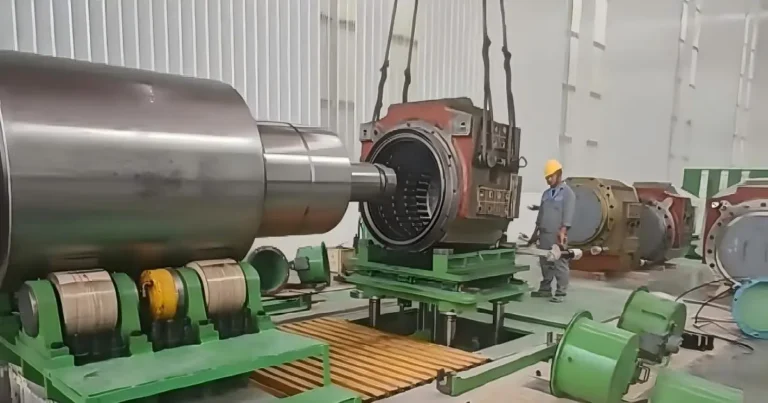
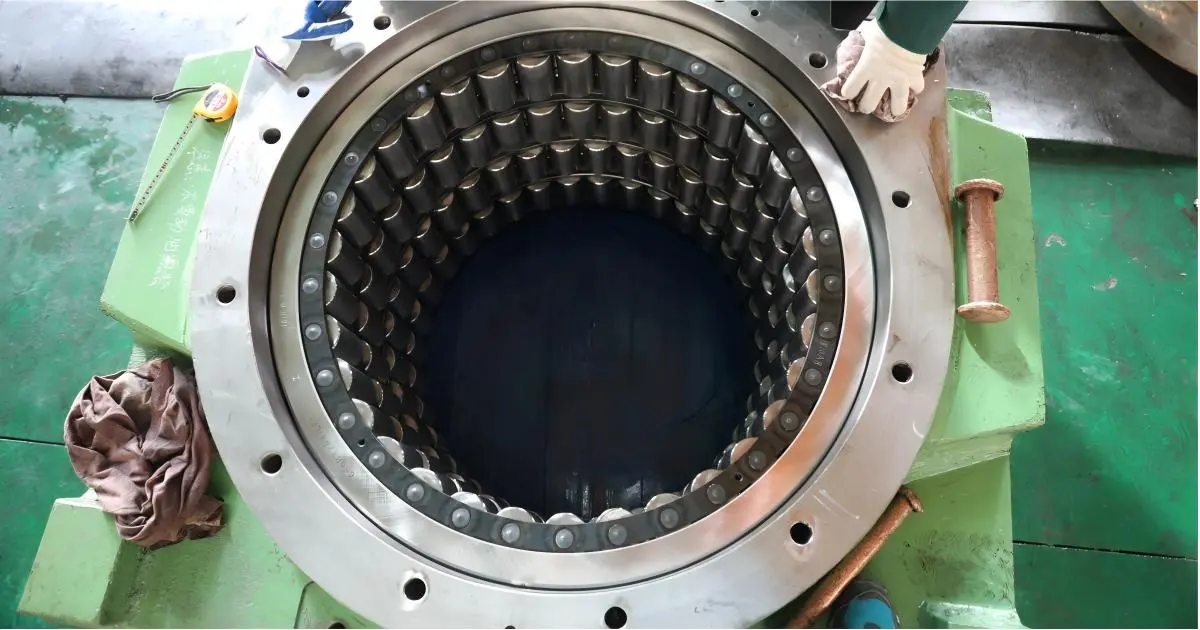
A damaged roll neck bearing does not identify its own cause. Spalling, dents, rust or discoloration can come from load, lubrication, contamination, mounting or a combination of these. Replacing the bearing without finding the cause can repeat the failure.
This guide explains what to record before cleaning a removed bearing, what common damage patterns can indicate, and what to correct before fitting the replacement. For choosing bearing types and checking fits, see our guide to rolling mill bearing selection.
Appearance alone rarely proves the cause. Work in this order:
- Record first: mill type, position, operating hours and photographs before cleaning.
- Read the pattern: where the damage sits on the rollers and raceways matters as much as what it looks like.
- Check the entry paths: seals, water, scale and lubricant supply.
- Measure the interfaces: roll neck, chock bore and axial setting.
Do not treat a short service interval as proof of a bearing defect until these checks are done.
What Should You Record Before Cleaning a Removed Bearing?
Cleaning removes evidence. Photograph the bearing, rings, cages, spacers and nearby parts as removed, then note the conditions that surrounded the failure.
- Position: mill type, roll type and which end of the roll neck.
- Operating hours since the last installation, and the usual interval for this position.
- Matching marks: component order and orientation, especially on multi-row assemblies.
- Lubricant condition: colour, water, particles and deposits.
- Recent events: roll changes, stoppages, wrecks, seal or cooling-water changes.
- Photos of the roll neck and chock bore as well as the bearing.
Follow the mill’s isolation and handling procedures when removing heavy assemblies. For the routine around removal and fitting, see pre-installation checks and common mistakes; the same record-keeping logic applies, although the equipment differs.
What Do Common Damage Patterns Suggest?
The table lists patterns that are often seen on removed rolling bearings. It shows what each one can point to, not what it proves.
| Observation | May indicate | Check next |
|---|---|---|
| Flaking or spalling on rollers or raceways | Rolling contact fatigue, which can have several contributing causes | Load history, lubricant film, surface dents, edge loading, material records |
| Dents or scratches on the contact surfaces | Hard particles passing through the contact | Seals, scale entry, lubricant cleanliness, filtration |
| Dull, worn or abraded surfaces | Abrasive contamination or poor lubricant condition | Water and debris in the lubricant, seal condition |
| Rust marks or etched patches | Water ingress, or moisture during standstill | Seals, cooling-water routing, drainage, storage conditions |
| Discoloration or smeared surfaces | Overheating, lubricant starvation or skidding | Lubricant supply and return, speed and load conditions, clearance |
| Wear concentrated at one edge or one side | Misalignment or uneven load across the roller rows | Chock and roll neck geometry, housing deformation, roll deflection |
| Polished or fretted marks on bore or outside diameter | Ring movement from a loose fit or damaged seat | Roll neck and chock bore measurements, shoulders and faces |
More than one pattern can appear on the same bearing. A rust pit, for example, can start a fatigue crack, so the first visible damage may not be the original cause.
How Should Contact Fatigue Marks Be Assessed?
Contact fatigue shows up as small flaking or pitting on the surfaces where rollers and raceways carry load. It is a result, not a root cause. The question is why the surface was stressed beyond its capacity at that interval.
Look at where the marks sit and how they are distributed:
- Both rollers and raceways affected: points toward the contact condition as a whole, such as load, lubrication or surface quality, rather than one damaged part.
- One side or one row only: often points to uneven load sharing, alignment or axial setting.
- Marks starting at dents or rust pits: point to contamination as the starting point.
- Marks at roller ends or edges: point to edge stress, which can relate to roller profile, misalignment or deflection under load.
Photograph the pattern before cleaning and compare it with the operating record. The descriptions in how to read bearing damage patterns cover spalling, pitting, smearing and heat tint, and they apply to roll neck bearings as well.
A short interval does not by itself show a manufacturing defect. Compare it with the previous interval at the same position, and check whether loads, rolling schedules or maintenance practice changed.
How Do Water, Scale and Lubricant Problems Damage a Roll Neck Bearing?
Mill positions expose bearings to cooling water, scale and process debris. These enter through worn seals, damaged running surfaces or open components during maintenance. Once inside, they can dent surfaces, corrode them, or break down the lubricant film.
- Seals and covers: inspect running surfaces, mating faces and joints for wear and leakage paths.
- Lubricant supply: confirm that bearing lubrication holes and grooves line up with the chock passages in the installed orientation.
- Return and drainage: blocked returns can affect cooling, distribution and sealing.
- Lubricant condition: water, particles or changed colour in the lubricant are evidence worth recording.
- Product changes: check compatibility before switching lubricants or mixing greases.
For a systematic way to read the lubricant and check the supply route, see crusher bearing lubrication. It is written for crushers, but the lubricant-condition checks carry over to any heavily contaminated application. The mill-specific points on lubrication and sealing are in section 5 of the selection guide.
Case: Early Contact Fatigue in a KOCKS-Type Rod Mill Stand
TEDIN’s KOCKS-type rod mill stand case shows how an inspection record can shape a replacement review. The following points are taken from that case record.
- The customer reported contact fatigue marks on the roller and raceway surfaces after about 2,700 operating hours, supported by inspection photographs.
- TEDIN reviewed the bearing arrangement as a complete set rather than matching dimensions alone. The review covered the contact surfaces, bearing steel cleanliness, the roller surface profile of the double row cylindrical roller bearings, and matched supply of the set.
- The replacement set was a pair of double row cylindrical roller bearings with a matched angular contact ball bearing set and spacer, supplied to the existing housing arrangement.
- By the time of customer feedback, the replacement set had been reported at more than 7,500 operating hours without the same early fatigue pattern. Repeat supply for this application has continued for 7 to 8 years.
This is a record for one stand. It does not show which of the changes contributed most, and it is not a service-life figure for other mills. Operating conditions, lubrication and maintenance practice also affect results. What the case does show is the sequence: record the damage and the hours, review the whole arrangement, then specify the replacement.
What Should Be Corrected Before Fitting the Replacement?
A correctly specified bearing can still fail early if the cause remains in the assembly. Before fitting:
- Roll neck and chock bore: measure against the drawing tolerances, including roundness, taper, shoulders and locating faces. Record any wear or fretting.
- Seals and covers: replace or repair worn running surfaces and damaged seals, not only the bearing.
- Lubrication path: confirm passages are clear and aligned, and that the lubricant matches the specification.
- Axial setting: use the specified setting method for the exact arrangement. Do not apply a generic value, and do not mix rings or spacers from different matched assemblies unless compatibility is confirmed.
- Original specification: compare designation, clearance and tolerance class with the original, as set out in the selection guide.
If the same position fails repeatedly, treat it as a system problem. Review load, alignment, sealing and lubrication before changing bearing brand or type.
What Should You Send for a Failure Review?
These details let TEDIN check the application before proposing a replacement:
- Bearing designation or drawing, including all markings and suffixes.
- Mill type, roll type and bearing position.
- Operating hours before removal and the usual interval.
- Photos of the bearing, roll neck and chock, taken before cleaning.
- Lubrication and sealing details, including any water or scale problems.
- Previous replacements and what changed between them.
Send the details through our contact page, or review the range of rolling mill bearings first. For roll neck positions, see four row cylindrical roller bearings and four row tapered roller bearings.
Frequently Asked Questions
What causes contact fatigue in rolling mill bearings?
Several factors can contribute: heavy or uneven load, a poor lubricant film, surface dents from contamination, corrosion pits, misalignment, and material or surface quality. Usually more than one is involved, so check the operating record and the mating parts as well as the bearing.
Does early spalling always mean the bearing was defective?
No. Early spalling can come from contamination, lubrication faults, mounting problems or load conditions. Compare the interval with earlier ones at the same position and inspect the roll neck, chock and seals before drawing a conclusion.
Can water and scale cause roll neck bearing failure?
Yes. They can enter through worn seals or open joints, dent or corrode the contact surfaces, and weaken the lubricant film. Photograph rust, deposits and lubricant condition before cleaning, and correct the entry path as part of the repair.
Should I replace only the damaged bearing?
It depends on the arrangement. Where bearings, rings or spacers form a matched set, replacing one part alone may be unsuitable. Follow the equipment and bearing documentation, and assess the condition of the whole assembly.
How many operating hours should a rolling mill bearing last?
There is no single figure. Service life depends on the mill, position, loads, speed, lubrication and sealing. Use your own record for the same position as the reference, and treat a sudden drop in interval as a reason to investigate.