Ask a maintenance crew why a crusher bearing failed and the first answer is often “bad bearing”. Pull the housing apart and the story is frequently about the lubricant: too little, too much, the wrong type, or a good lubricant that was contaminated before it reached the rolling elements.
This guide is about judging and checking, not about fixed numbers. Grease quantities, relubrication intervals and oil grades depend on the crusher design, bearing size, speed and temperature, so take those values from the crusher manufacturer. What follows will help you decide what to look at and what the lubricant is telling you. For the wider picture of bearings in harsh duty, see TEDIN’s mining and construction bearing solutions.
Grease or oil is usually decided by the crusher design, not by preference. In either case:
- Look at the lubricant itself: colour, consistency, water and metal particles.
- Check the delivery: grease lines, relief paths, oil flow, filters and coolers.
- Avoid both extremes: starved bearings and overfilled housings both run hot.
- Do not mix products without confirmation from the lubricant supplier.
Grease or Oil: Who Decides?
On most crushers the question was answered at the design stage. The housing, seals, drain and supply arrangements are built for one method. Converting a grease-lubricated position to oil, or the other way round, is an engineering change, not a maintenance tweak.
Still, it helps to know what each method does well, because it explains where problems tend to appear.
| Point | Grease | Oil (bath or circulating) |
|---|---|---|
| Typical strength | Stays in the housing and helps seal out dust. Simple supply. | Carries heat away and can be filtered, cooled and monitored. |
| Typical weakness | Holds heat and contamination. Easy to over- or under-supply. | Needs seals, pumps, filters and a working return path. |
| What goes wrong first | Blocked lines, hardened grease, overfilled housing, mixed products. | Water in the sump, clogged filter, low flow, aged oil. |
| Best clue for diagnosis | Grease purged from the relief point or taken from the housing. | Oil sample, sight glass, filter debris and flow readings. |
Heat is the practical dividing line. Heavy, continuously loaded positions that generate a lot of heat tend to favour oil with circulation and cooling. Positions with lower speed, easier dust sealing and simpler access are often greased. Check the crusher manual for the specified method at each bearing position, because a single machine can use both.
Read the Lubricant Before You Change Anything
A sample of used grease or oil is cheap evidence. Take it from the bearing housing, not only from the nipple or the tank, and note where it came from.
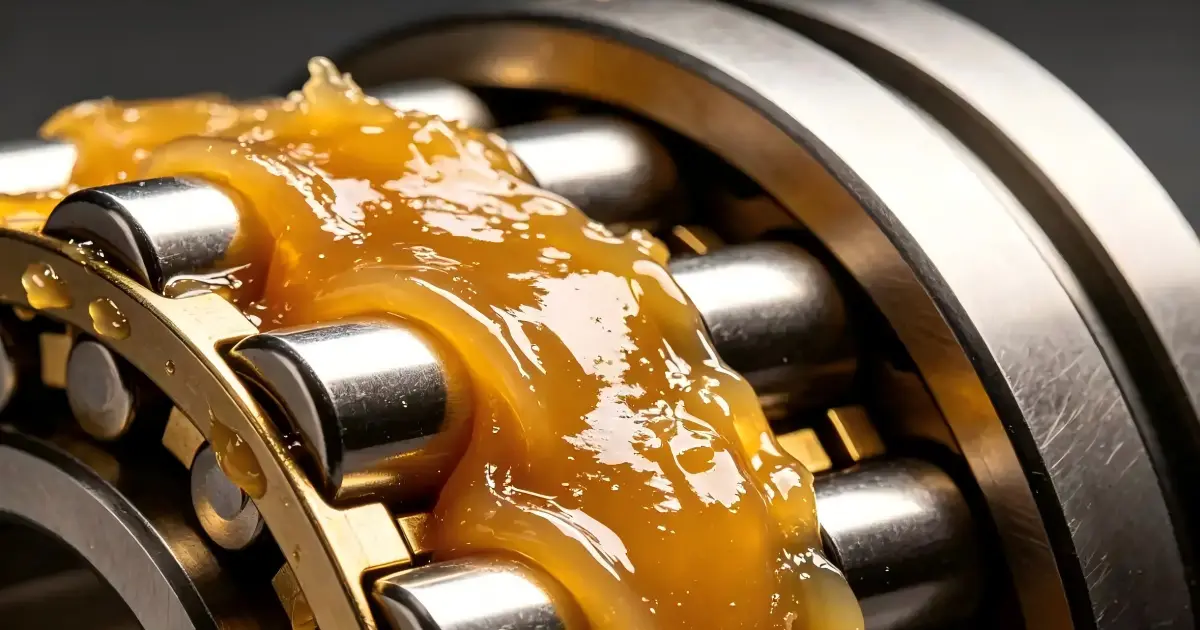
What to look for in grease
- Colour change. Darkening can come from heat, oxidation or fine wear debris. Compare against fresh grease of the same brand.
- Hard, dry or crusty grease near the seal or at the edge of the housing. The oil has separated or been driven out and what remains no longer lubricates well.
- Milky or washed-out texture. This usually points to water, especially on machines cleaned with a hose or running in wet feed.
- Grit or glitter between the fingers. Rub a small amount on a clean surface. Hard grit means contamination; bright metallic flecks suggest wear and deserve a closer look at the bearing.
- Very soft, runny grease that slumps and leaks. It may have been mixed with an incompatible product or exposed to temperatures beyond its limit.
What to look for in oil
- Cloudy or milky oil in the sight glass or sample, which indicates water.
- Dark, burnt-smelling oil, a sign of overheating or oil that has been in service too long.
- Debris on the filter or magnetic plug. A little fine material can be normal. Flakes, chips or a sudden increase are not.
- Foam or air bubbles, which can point to a return line, level or pump problem.
None of these observations proves the cause alone. Put them next to temperature records, vibration trends and what the removed bearing looks like. If you are comparing damage patterns, gearbox bearing failure causes shows how the same rolling-bearing damage types are read in a closed drive.
Too Little, Too Much, Wrong Product
Starved bearings
When the contact surfaces are not separated by a film, you get metal contact, rising friction and heat. It tends to show as a gradual temperature climb after a long gap between servicing, or as a bearing that was “dry” the moment the grease line was opened.
Overfilled housings
Less obvious and just as common. A bearing housing packed full of grease forces the rolling elements to churn through it, which generates heat. The grease softens, leaks past seals and draws dust back in. A typical story: temperature rises right after a lubrication round, then settles slowly. If that pattern repeats, suspect over-greasing before suspecting the bearing. Do not add more grease because the bearing is hot without finding out why it is hot. See crusher bearing overheating: causes and what to check for the broader checklist.
Mixed or unsuitable products
Greases with different thickener types are not always compatible. Mixing them can change the consistency and reduce performance. When a crusher changes hands, or a site switches suppliers, ask the lubricant supplier to confirm compatibility, or purge according to the supplier’s guidance. Record the product name in the maintenance log so the next person does not have to guess.
Viscosity matters too. A lubricant that is too thin at operating temperature will not carry the load, and one that is too thick builds friction at start-up and low temperatures. The correct grade depends on speed, load and temperature, so use the crusher manufacturer’s recommendation or ask the lubricant supplier to calculate it.
Contamination Is Usually the Real Enemy
A crusher produces dust all day. The lubricant does not have to be wrong to fail; it only has to be dirty. The common entry points are easy to list:
- Grease nipples and fittings that are not wiped before use.
- Shared grease guns used across different positions or products.
- Worn, damaged or poorly fitted seals and labyrinths.
- Breathers that are blocked, missing or placed where dust collects.
- Water from washdown, rain or condensation in a sump.
- Open containers and unclean funnels during oil top-ups.
Hard particles in the contact zone dent the raceways. Each dent becomes a stress point, and the bearing may fail from surface damage long before normal fatigue life. That is one reason a bearing with perfect specifications can still fail early. If you want to understand how the clearance and bearing choice interact with operating temperature, read C3 vs. C4 clearance in spherical roller bearings.
Check the Delivery System, Not Just the Lubricant
Good lubricant that never arrives behaves like no lubricant. Before replacing a bearing, walk the supply route.
Grease systems
- Confirm that each line carries grease to its bearing and has not been kinked, crushed or blocked.
- If there is a centralised pump, check that it is delivering and that each distributor block is cycling.
- Make sure the relief or purge path is open, so old grease can leave the housing.
- Check that a fitting was not replaced with the wrong type, or painted over.
Oil systems
- Check oil level and temperature at the sump and at the bearing return.
- Inspect filters for blockage or a rising pressure drop.
- Verify that the cooler is clean and that the cooling medium is flowing.
- Confirm the return line drains freely and does not back up into the housing.
On a recently overhauled crusher, also confirm that nothing was reassembled incorrectly. A missing plug, a reversed seal or an unconnected line is easy to miss and can undo careful work. These checks fit naturally into the routine in crusher bearing replacement: pre-installation checks and common mistakes.
Lubrication Differs by Crusher Type
The arrangement changes what you check first.
- Jaw crushers. Eccentric shaft and toggle-related positions work under heavy shock loads. Check seals and grease routes carefully, and read the selection notes in jaw crusher bearing selection.
- Cone crushers. Different positions carry radial and axial loads and may use different lubrication arrangements. Identify the position before you decide what to check. Cone crusher radial vs. thrust bearings explains how those positions are split.
- Impact crushers and similar. High rotor speed and vibration make sealing, level control and grease retention more demanding. Follow the machine manual.
Related reading by machine: jaw crusher bearings and cone crusher bearings. In many positions the load and shock suit spherical roller bearings, though the right type always depends on the machine design.
Three Situations Maintenance Teams Often Run Into
These are common patterns, not case studies from a specific site.
1. Hot right after servicing
The crew greases the bearing, and within an hour the housing is noticeably hotter than before. Over-filling is the first suspect. Check whether the relief path is open and whether the greasing quantity matched the instruction.
2. Repeat failure with a “good” lubricant
New bearings keep failing at the same position, and the grease looks fine in the pot. Take a sample from inside the housing. Contamination at the seal, or a nipple that is never cleaned, will not show up in the drum.
3. Different people, different grease
One shift uses one product and the next uses another. Nothing fails right away, but the grease in the housing turns soft and leaks. Standardising the product, labelling the guns and logging each service solves a surprising number of these.
What to Record at Every Lubrication Check
- 1Product name and batch, so mixing can be traced.
- 2Quantity added and where it was added.
- 3Lubricant condition at the housing: colour, texture, water, particles.
- 4Bearing temperature before and after service.
- 5Seal and breather condition, including leaks and dust build-up.
- 6Oil level, flow and filter state for circulating systems.
- 7Operating conditions at the time, including load and feed.
A log like this turns “the bearing failed” into an explanation, which is what makes a replacement last.
What to Send for a Lubrication-Related Bearing Review
If a bearing has failed and you suspect lubrication, these details help identify what to look at next.
- Crusher model and bearing position.
- Bearing designation, including any suffix.
- Lubrication method and product used, grease or oil.
- Service history: how it was lubricated and by whom, if known.
- Operating data: speed, load, feed material and ambient conditions.
- Photos of the removed bearing, the lubricant and the housing.
You can contact TEDIN’s bearing support team to have the application reviewed before ordering a replacement.
Frequently Asked Questions
Is grease or oil better for a crusher bearing?
Neither is better in general. The crusher design determines the method for each position. Oil, with circulation and cooling, suits heavy continuous duty that generates a lot of heat. Grease is simpler and helps retain and seal in dusty environments. Follow the manufacturer’s specification for the position.
How often should crusher bearings be lubricated?
It depends on the crusher, bearing size, speed, load, temperature and contamination. Use the interval from the equipment manual, then adjust it using what you find in the lubricant and in the bearing temperature trend, with the manufacturer’s approval.
Can adding more grease fix a hot bearing?
Not as a first step. A hot bearing can be starved, but it can also be overfilled, misaligned, contaminated or overloaded. Find the cause before adding lubricant; adding more to an already full housing can make the temperature worse.
Can I mix different greases?
Only if the lubricant supplier confirms compatibility. Different thickener types or base oils can change consistency and reduce performance. Record the product used at each position so mixing can be avoided or traced.
What does milky grease or oil mean?
It usually means water has entered the lubricant. Check seals, breathers, washdown practice and sump condensation, and treat the lubricant as compromised until it has been replaced or assessed.
What should I send if I need help choosing a replacement bearing after a lubrication failure?
Send the crusher model, bearing position, existing designation, lubrication method and product, operating data, and photos of the bearing and lubricant. Contact TEDIN’s bearing support team for an application review.