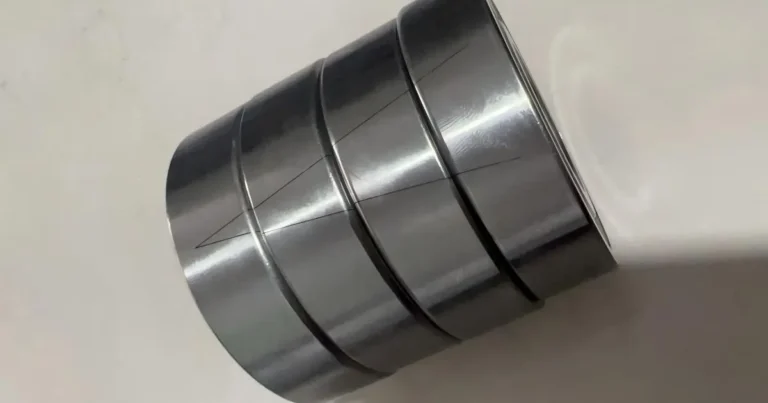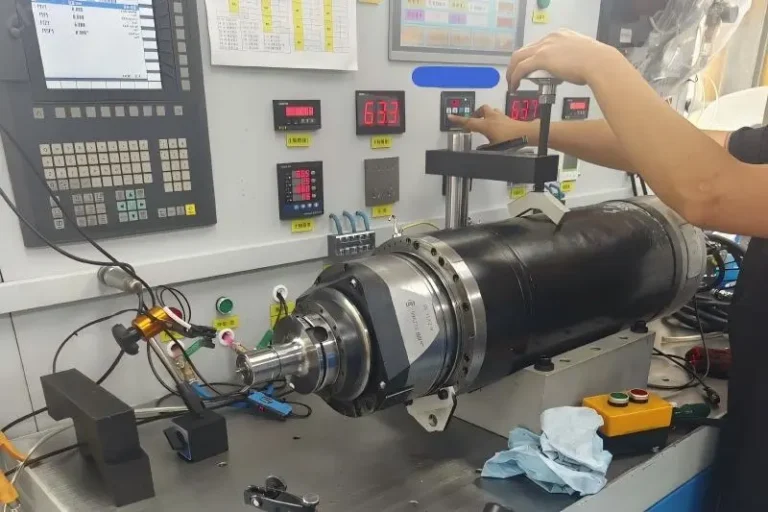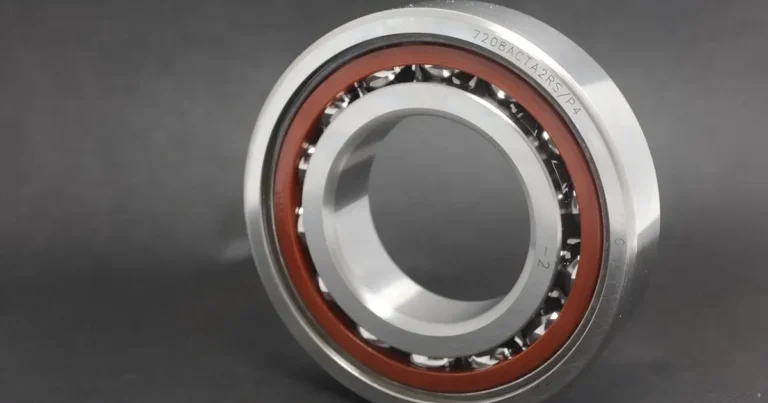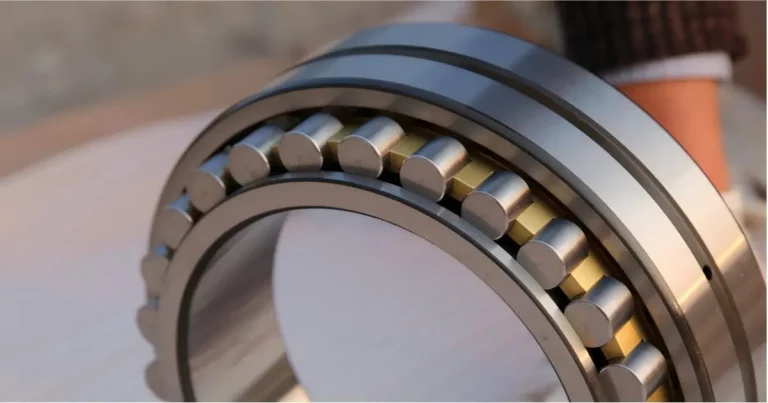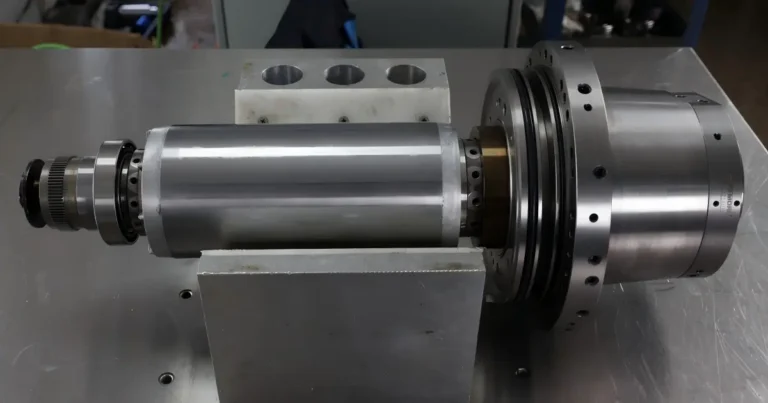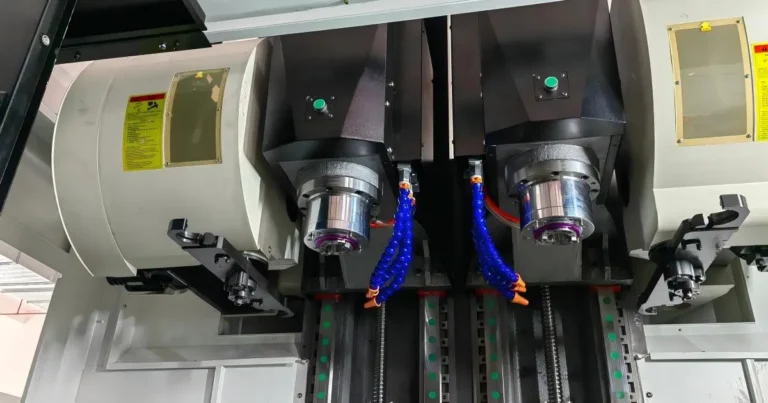
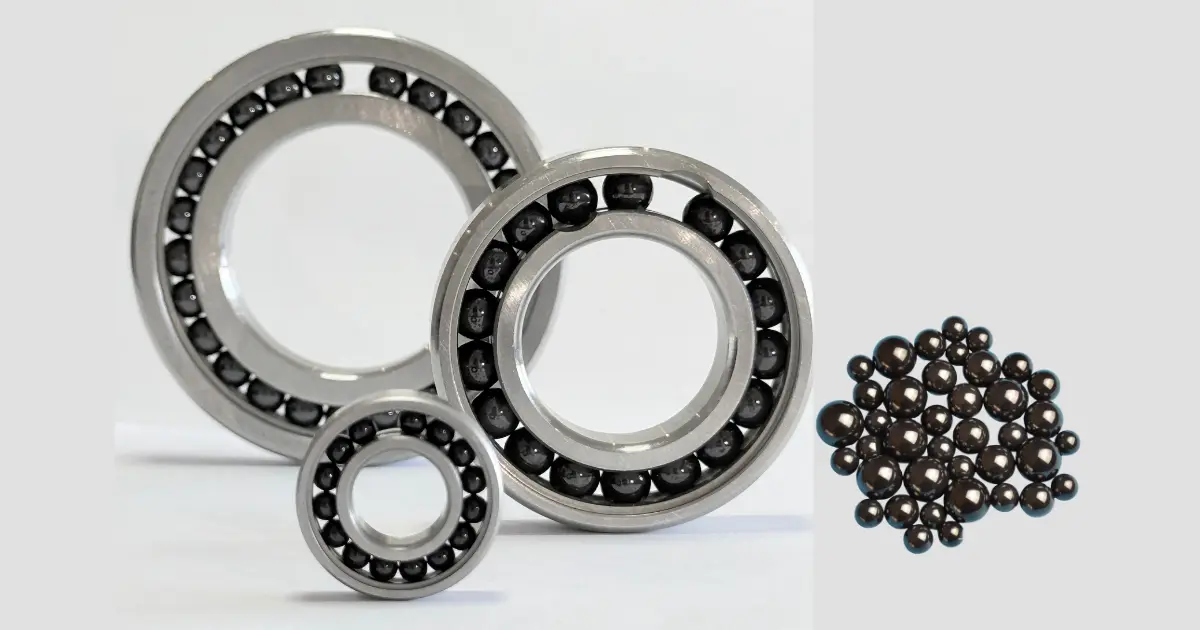
The main difference between hybrid ceramic and steel ball spindle bearings is the rolling element material. Hybrid bearings use silicon nitride (Si₃N₄) balls with steel rings; steel ball bearings use steel for both. The ceramic balls are about 60% lighter than steel balls of the same size, which reduces centrifugal loading at high speed.
That advantage matters most when speed and heat generation constrain spindle performance. If a steel ball bearing already meets the required speed, running accuracy and operating temperature, changing to a hybrid design needs a specific performance or maintenance benefit to justify the higher purchase cost.
What Is a Hybrid Ceramic Spindle Bearing?
A hybrid ceramic spindle bearing has steel inner and outer rings and ceramic balls, usually made from silicon nitride. It is different from a full ceramic bearing, which also has ceramic rings.
Compared with bearing steel, silicon nitride has lower density, a higher elastic modulus and lower thermal expansion. These properties change how the balls behave under load and at speed. They do not determine the bearing’s accuracy grade or make the steel raceways immune to wear and damage.
For precision angular contact ball bearings, the full specification still matters: contact angle, internal geometry, cage, accuracy grade and preload. Two bearings with the same external dimensions can have different operating limits.
Hybrid Ceramic vs. Steel Ball Bearings at a Glance
| Comparison | Hybrid Ceramic Bearings | Steel Ball Bearings |
|---|---|---|
| High-speed capability | Higher speed potential | Lower speed potential |
| Ball material | Silicon nitride (Si₃N₄) | Bearing steel |
| Ring material | Steel | Steel |
| Ball mass | About 60% lighter than steel balls | Heavier at the same ball size |
| Ball centrifugal force | Lower at the same speed | Higher at the same speed |
| Ball thermal expansion | Lower | Higher |
| Lubrication | Required | Required |
| Typical purchase cost | Higher | Lower |
Comparison assumes otherwise comparable bearing designs and operating conditions. Ball mass is compared at equal ball size; centrifugal force is compared at equal orbital radius and speed. Actual permissible speeds must be checked for the specified bearing arrangement, preload and lubrication.
The main advantage for high-speed spindles is lower ball mass. Lighter ceramic balls reduce centrifugal loading, giving hybrid bearings greater high-speed potential than comparable steel ball designs.
Why Does Lower Ball Mass Matter at High Speed?
As spindle speed increases, centrifugal forces on the balls become more significant. In an angular contact bearing, these forces affect the loads and contact angles at the inner and outer raceways. Lighter ceramic balls reduce this contribution to the bearing’s internal loading.
This is one reason hybrid bearings are used in high-speed spindles. Lower ball mass can help reduce high-speed losses, but the permissible speed must still be checked for the actual bearing arrangement. A single-bearing catalogue speed is not automatically the operating limit for a preloaded pair or multi-bearing group.
Do not estimate the speed increase from the ball mass reduction. Balls that are about 60% lighter do not mean a spindle can run 60% faster. Cage design, preload, lubrication and cooling must support the proposed operating speed.
When specifying machine tool spindle bearings, record the continuous working speed as well as the maximum speed. A spindle running near its upper limit throughout a machining cycle needs a different thermal assessment from one that reaches that speed only briefly.
Will Hybrid Bearings Run Cooler?
A suitable hybrid design can reduce bearing heat generation at high speed. It will not solve overheating caused by excessive preload, excess grease, an incorrect oil supply or unsuitable shaft and housing fits.
If an existing spindle runs hot, check the installation and lubrication before changing ball material. Otherwise, the replacement may repeat the same problem at a higher cost.
Lower ceramic-ball thermal expansion also does not guarantee constant preload. The steel rings, shaft, housing and spacers still expand. Differences in their temperatures and expansion change the bearing’s operating preload.
For a replacement or upgrade, compare temperature rise through the actual working cycle using consistent measurement locations and cooling conditions. A brief no-load test does not establish thermal performance during sustained cutting.
Are Hybrid Bearings Stiffer or Able to Carry More Load?
Silicon nitride has a higher elastic modulus than bearing steel. In otherwise comparable contact geometry, this changes elastic deformation and can increase contact stiffness. Spindle stiffness, however, also includes the bearing arrangement, preload, shaft, housing and tool interface.
Higher ball stiffness is not the same as higher bearing load capacity. The ceramic–steel contact has different contact stresses from a steel–steel contact. Use the published dynamic and static load ratings for the specific hybrid bearing rather than transferring ratings from a steel ball version.
For heavy cutting or interrupted cuts, review peak loads as well as average loads. Increasing preload to gain rigidity also raises internal loading and can reduce the available speed margin.
Ball material does not determine running accuracy, either. Specify the required accuracy grade and mounting tolerances for both bearing types.
Do Hybrid Ceramic Bearings Need Lubrication?
Yes. Lubrication is still needed at the rolling contacts and at sliding contacts involving the cage and balls. The steel rings also require corrosion protection.
Ceramic balls do not make a conventional spindle bearing suitable for dry running. Do not reduce grease quantity or oil-air delivery simply because the replacement bearing is a hybrid design.
Follow the approved lubricant specification, fill quantity or oil supply settings, and run-in procedure. Excess grease can increase churning losses and temperature; insufficient lubricant can damage the contacts. The correct supply is determined by the bearing design and operating conditions.
When Is a Steel Ball Bearing the Better Value?
A steel ball bearing is a sound choice when it meets the spindle’s requirements without operating close to its speed or thermal limits. There is little reason to pay for a material change that does not address a defined problem.
Retaining the steel ball design is particularly reasonable when:
- Speed capacity is sufficient: The approved bearing arrangement covers the continuous and maximum operating speeds.
- Temperature is stable: The spindle stays within its specified temperature limits throughout the working cycle.
- Machining performance is satisfactory: Running accuracy, rigidity and surface finish meet the machine’s requirements.
- Service history is acceptable: Bearing replacements are not being driven by an unresolved high-speed or thermal problem.
For machine tool bearing selection, compare the complete bearing specifications and the expected benefit. Purchase price alone is not the whole cost, but neither is a hybrid bearing automatically the more economical option over its service life.
Can Steel Ball Bearings Be Replaced with Hybrid Bearings?
They can be replaced with a suitable, approved hybrid design, but equal bore, outside diameter and width do not establish interchangeability. The replacement must meet the spindle’s matching, preload, load and speed requirements.
Before ordering, confirm:
- Bearing identity: Full designation, manufacturer reference and any set markings.
- Internal specification: Contact angle, accuracy grade, ball and cage design.
- Matching and preload: Approved matching designation, preload or clearance class, and specified value where available.
- Arrangement: DB, DF, DT or the complete multi-bearing sequence.
- Operating limits: Continuous speed, maximum speed, dynamic and static load ratings.
- Mounting: Shaft and housing fits, spacer dimensions and clamping requirements.
- Lubrication and cooling: Lubricant, supply settings, cooling conditions and run-in procedure.
A preload suffix used for a steel ball bearing does not, by itself, prove that a hybrid replacement will produce the same installed preload. Confirm the manufacturer’s specification and the mounting conditions.
Do not mix steel ball and hybrid bearings within a matched group unless the manufacturer approves the combination. Differences in contact behavior can change load sharing and preload.
Before machine tool bearing replacement, photograph the bearing markings and record the installation sequence. After fitting an approved replacement, complete the specified run-in and check temperature, vibration and running accuracy before returning the spindle to production.
Which Bearing Type Should You Choose?
Choose a hybrid design when its lower ball mass addresses a defined high-speed requirement and the complete bearing specification meets the spindle’s load and preload needs. Verify the benefit against the actual duty cycle, not just the machine’s maximum rpm.
Keep a steel ball design when it already delivers the required speed, accuracy and thermal performance at an acceptable cost. If the reason for changing bearings is heat, vibration or short service life, establish the cause first. Changing ball material is not a substitute for correcting the bearing system.