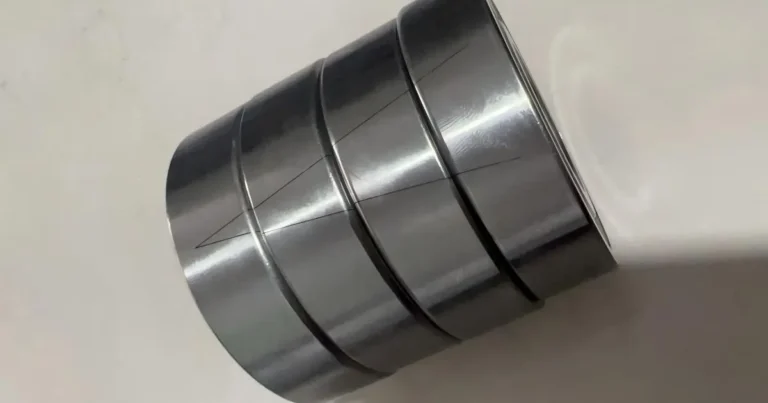
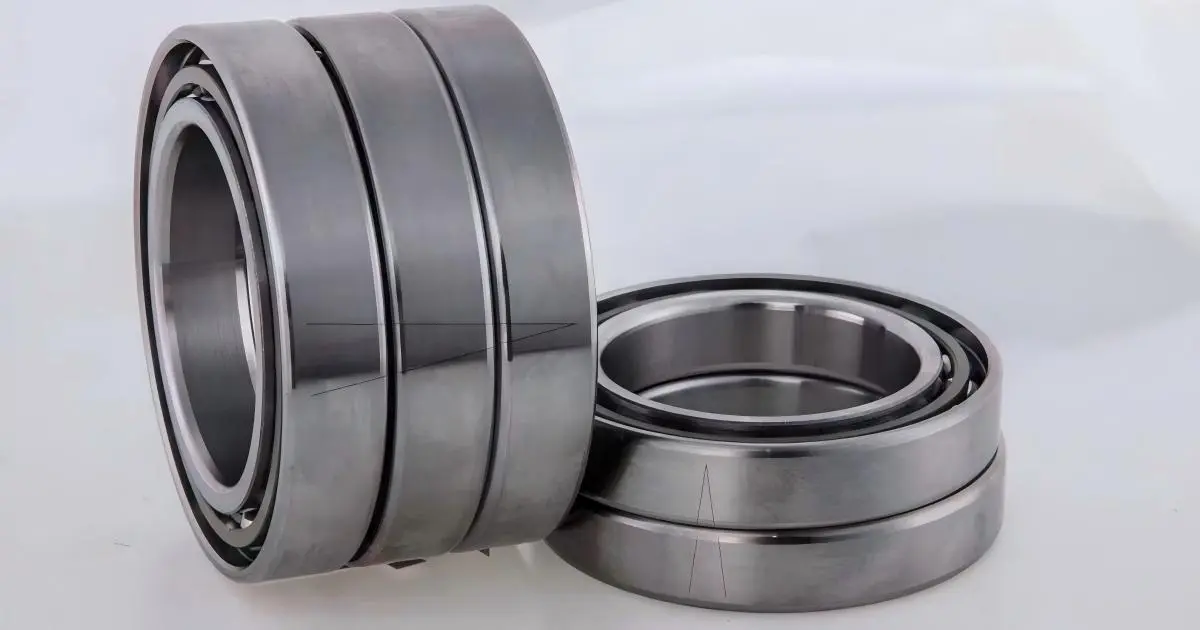
Two angular contact bearings can have the same part number and still behave differently when their mounting direction changes. Put them back-to-back or face-to-face, and the pair can support axial loads in both directions. Put them in tandem, and both bearings support axial load in the same direction.
These three angular contact bearing arrangements—DB, DF and DT—also differ in how they resist tilting moments. Choosing between them means looking at the load direction and the complete shaft support, not just the space available for two bearings.
What Do DB, DF and DT Mean?
A single-row angular contact ball bearing supports combined radial and axial loads, but its axial load capacity acts in one direction. Bearings are therefore often used together to provide the support a shaft needs.
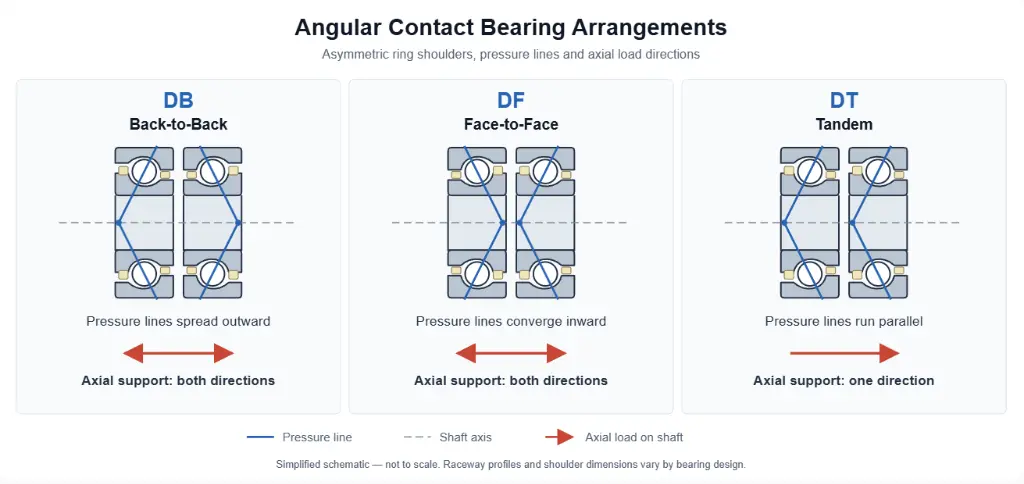
- DB — back-to-back: the pressure lines spread outward, forming an O-shaped pattern.
- DF — face-to-face: the pressure lines converge inward, forming an X-shaped pattern.
- DT — tandem: the pressure lines run parallel in the same direction.
The pressure lines show the direction through which the bearing transmits load. For DB and DF pairs, where these lines meet the shaft axis helps explain the difference in effective support span.
DB: Back-to-Back for Moment Stiffness
In a DB arrangement, the pressure lines spread outward. This creates a wider effective support span than a comparable DF pair.
That wider span helps the pair resist a tilting moment—for example, when a cutting load acts on a tool extending beyond the front spindle support. With the same bearings and comparable mounting conditions, DB generally provides greater moment stiffness than DF.
A DB pair supports radial loads and axial loads in both directions. It is a common choice where shaft positioning and resistance to tilting matter.
The trade-off is sensitivity to misalignment. Shaft bending or inaccurate bearing seats can disturb the load distribution. DB is not a way to compensate for poor shaft or housing geometry.
DF: Face-to-Face with a Shorter Effective Span
In a DF arrangement, the pressure lines converge inward. The effective support span is shorter, so a comparable pair usually has lower moment stiffness than DB.
Like DB, a DF pair supports radial loads and axial loads in both directions. It is generally more accommodating of small misalignment than a comparable DB pair, which can be useful in some shaft layouts.
DF is not self-aligning. Any permitted misalignment still depends on the bearing design, preload, load and mounting conditions. If the shaft or housing is out of tolerance, changing from DB to DF is not a repair.
DT: Tandem for Axial Load in One Direction
In a DT arrangement, both bearings face the same way. Their pressure lines are parallel, allowing a properly matched pair to share axial load in one direction.
Tandem arrangements are useful when a single bearing cannot provide the required axial capacity. Do not assume that adding a second bearing simply doubles the usable capacity: the result depends on matching, load sharing and the applicable bearing calculation.
A DT pair does not provide axial support in the opposite direction. If the shaft needs bidirectional axial positioning, the overall arrangement needs opposing support. This may be another bearing or an opposing bearing group, depending on the design.
DB vs. DF vs. DT: Practical Comparison
| Characteristic | DB: Back-to-Back | DF: Face-to-Face | DT: Tandem |
|---|---|---|---|
| Pressure lines | Spread outward; O-shaped pattern | Converge inward; X-shaped pattern | Parallel and in the same direction |
| Axial load support | Both directions | Both directions | One direction |
| Moment stiffness | Generally higher than a comparable DF pair | Generally lower than a comparable DB pair | Assess through the complete support layout |
| Misalignment sensitivity | Generally more sensitive than DF | Relatively more accommodating, within strict limits | Requires suitable alignment for load sharing |
| Main reason to choose it | Bidirectional positioning and resistance to tilting | Bidirectional support where the layout favors DF | Greater axial capacity in one direction |
| Main check before use | Bearing-seat alignment and required stiffness | Whether moment stiffness meets the requirement | Load sharing and opposing axial support |
The DB–DF stiffness comparison assumes the same bearing type, contact angle and comparable preload and mounting conditions. It is not a ranking of every DB assembly against every DF assembly.
Which Arrangement Should You Choose?
Start with two questions: Which direction does the axial load act, and how much tilting moment must the support resist?
- Axial load in both directions, with a significant moment: DB is often the starting point. Check the bearing-seat alignment and the stiffness of the surrounding structure.
- Axial load in both directions, with a layout that favors DF: verify that its moment stiffness and permitted misalignment meet the design requirements.
- A high axial load mainly in one direction: consider DT, then establish how the shaft will be supported in the reverse direction.
Next, check contact angle, speed, lubrication and preload. The arrangement describes bearing orientation; it does not specify how tightly the bearings are loaded together. The required spindle bearing preload must be reviewed separately.
For a replacement, use the original arrangement unless a design review supports a change. A pair that fits into the same space may still change shaft stiffness, thermal behavior and axial positioning.
Matching Matters as Much as Orientation
Placing two standard bearings back-to-back does not automatically create a correctly preloaded pair. The relevant ring-face offsets and matching requirements must be controlled.
Factory matched angular contact bearing sets are supplied for specified assembly conditions. Universally matchable bearings offer more arrangement flexibility, but they must still meet the manufacturer’s compatibility and mounting requirements.
Before installation or replacement, check:
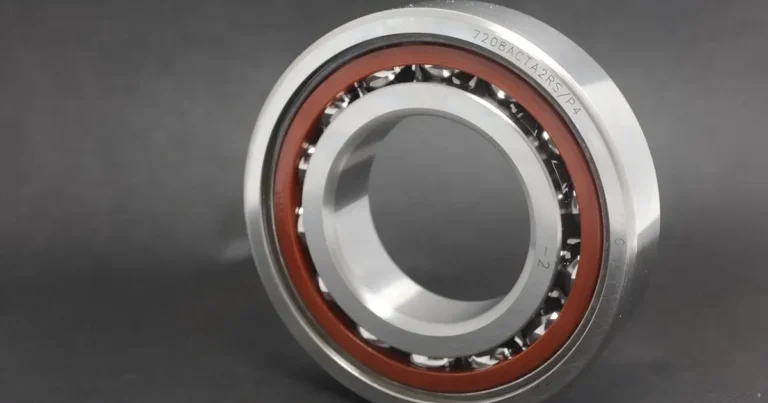
- The complete designation: include contact angle, preload and matching suffixes—not just the basic bearing number.
- The set markings: follow the supplier’s orientation and set-identification instructions. Do not judge direction from the printed brand name alone.
- The mounting parts: verify shaft and housing shoulders, spacers and clamping requirements against the drawing.
- The set condition: do not mix bearings from different matched sets or replace only one member without confirming that the combination is acceptable.
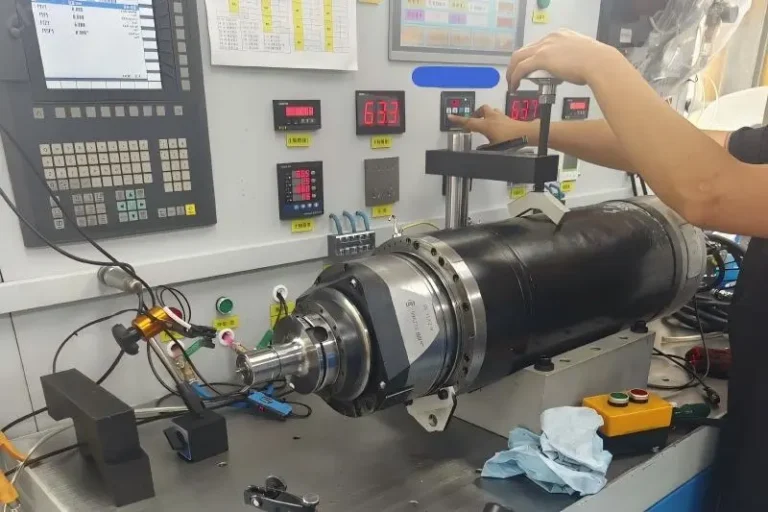
When checking a dismantled spindle, photograph the markings and record the bearing order before separating the set. This information is much harder to recover once the bearings have been mixed.
Frequently Asked Questions
Can I Change a DB Pair to DF by Flipping the Bearings?
Not as an automatic substitution. Some universally matchable bearings can be used in either arrangement under specified conditions. A dedicated matched set may have different restrictions. The shaft layout, preload, spacers and clamping must also be suitable for the change.
Does DT Mean Double the Preload?
No. DT describes orientation and axial load direction, not a preload value. Preload is established by the complete opposed support arrangement and its specified mounting conditions.
Are the Markings the Same Across Bearing Brands?
Do not assume so. DB, DF and DT are widely used arrangement terms, but matching suffixes and orientation marks can differ. Use the manufacturer’s documentation to interpret the complete designation.
Confirm the Arrangement Before Ordering
DB, DF and DT answer different support needs. DB offers a wider effective span, DF has a shorter span and relatively greater accommodation of small misalignment, and DT shares axial load in one direction. None is the best choice for every shaft.
For a replacement inquiry, send TEDIN the complete bearing designation, photos of the set markings and the original arrangement. For a new design, include the shaft drawing, load directions, speed and preload requirement. Contact our team to check the specification before ordering.