A brass cage is not automatically better than a steel cage for mining equipment. The suitable choice depends on the complete bearing design, including how the cage is guided, the operating speed, vibration and lubrication. Cage material is one part of the specification—not a stand-alone measure of bearing quality.
When comparing replacement spherical roller bearings, check more than the bore, outside diameter and width. Bearings with the same boundary dimensions can have different cage constructions and application requirements.
What Does a Spherical Roller Bearing Cage Do?
The cage separates the rollers, maintains their spacing and guides their movement through the loaded and unloaded zones. It also retains the rollers as part of the bearing assembly.
The main external load passes through the raceways and rollers, not through the cage. However, the cage still experiences forces from roller contact, friction and acceleration. Vibration, abrupt speed changes or poor lubrication can make those forces more demanding.
This is why cage selection cannot be reduced to which material looks stronger. The pocket geometry, guidance method and interaction with the rollers also affect performance.
Brass vs. Steel Cages: What Is Being Compared?
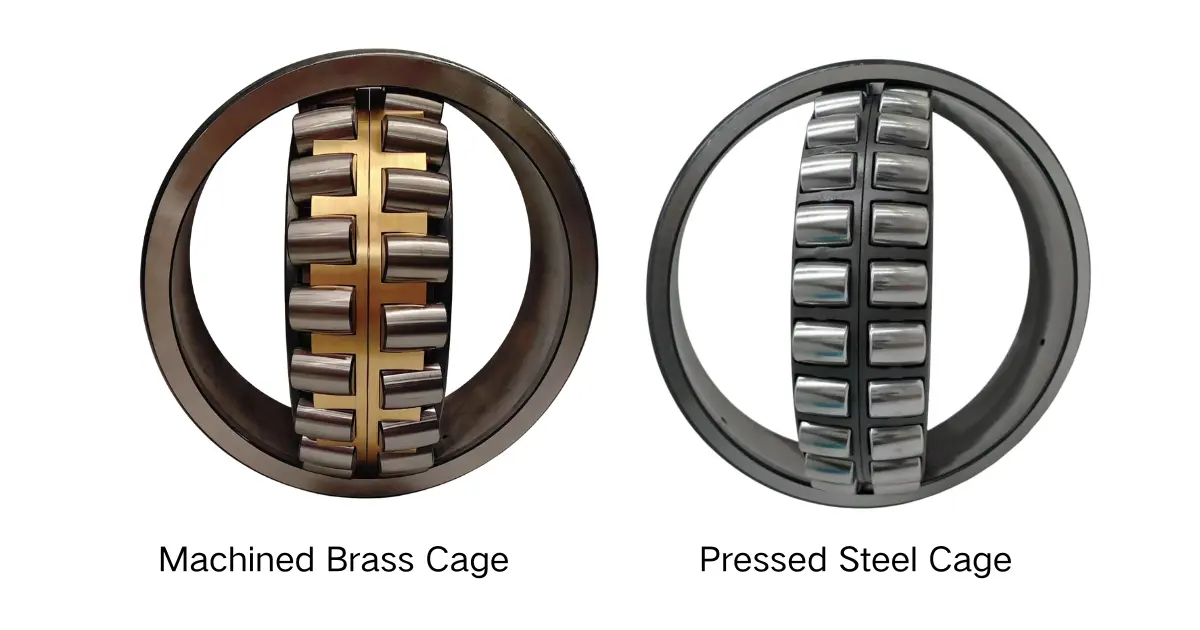
A common comparison is between a machined brass cage and a pressed steel cage. That comparison involves both material and construction. Machined steel cages also exist, so “steel cage” does not always mean the same design.
Machined Brass Cages
Machined brass cages are produced by machining cage pockets and guiding surfaces. Depending on the bearing design, the cage may be guided by the rollers or by a ring-associated guiding surface. They are available in various spherical roller bearing series, including designs intended for demanding industrial service.
The presence of a brass cage does not establish suitability for a particular crusher or vibrating screen. Confirm the manufacturer’s application limits and the complete bearing designation.
Pressed Steel Cages
Pressed steel cages are formed from sheet steel and are generally lighter than comparable machined brass constructions. Lower cage mass can be relevant where acceleration is significant, but it does not establish suitability on its own. Pocket design, guidance and the complete bearing construction still matter.
A pressed steel cage should not be treated as an inferior option simply because its sections are thinner. It may be the specified design for the bearing and operating conditions.
Compare complete bearing designs, not material names alone. Speed ratings, temperature limits and suitability for vibratory service must come from the documentation for the exact bearing.
What Matters in Mining Applications?
In mining equipment bearing applications, heavy loads often occur alongside dust, vibration and long operating hours. Those conditions affect the bearing as a system, including its cage, lubricant, fits and seals.
Vibration and Acceleration
Vibrating screen and exciter bearings experience continuous acceleration. A suitable cage must accommodate the resulting roller and cage movements. Some bearing designs are specifically intended for this service; cage material alone does not identify them.
For a screen replacement, confirm the screen or exciter specification and the full application-specific designation. A general-purpose bearing with a brass cage is not automatically equivalent to a bearing designed for vibration.
Speed and Cage Guidance
Check the operating speed against the manufacturer’s ratings for the exact bearing and lubrication arrangement. Cage mass, guidance and internal geometry can influence running behaviour, but there is no universal rule that all steel-cage bearings run faster than all brass-cage bearings.
Lubrication and Contamination
Lubricant must reach the roller contacts and cage-contact surfaces. Inadequate supply, unsuitable viscosity or abrasive contamination can cause wear regardless of cage material. Changing from steel to brass will not correct a blocked oil path or a failed sealing arrangement.
Temperature
Review the bearing’s temperature limits together with the lubricant, seals and dimensional-stability specification. Cage material by itself does not define the allowable operating temperature of the complete assembly.
Can You Replace a Steel Cage with a Brass Cage?
Sometimes, but only after checking the complete replacement specification. Matching dimensions does not confirm that two bearings have equivalent internal geometry, speed ratings or application suitability.
Before changing the cage design, check:
- Full designation: manufacturer, basic bearing number and every suffix.
- Cage construction: material, pressed or machined construction, and guidance method.
- Other bearing features: bore design, radial clearance, lubrication features and any application-specific requirements.
- Operating conditions: speed, load, vibration, temperature and lubricant supply.
- Equipment specification: the bearing required by the assembly drawing or maintenance documentation.
Cage suffixes are manufacturer-specific. The same letter should not be assumed to describe the same cage material or guidance method across brands. Use the designation guide for each manufacturer when reviewing an alternative.
If a cage has fractured or worn heavily, inspect the rollers, raceways, fits and lubrication system before choosing a different material. Cage damage may be associated with contamination, incorrect installation, roller skidding or abnormal operating conditions. The damaged cage alone does not prove that its material was unsuitable.
What to Send for a Replacement Review
Start with the complete bearing designation and clear photographs of the markings and cage. Add the equipment model, bearing position, operating speed and lubrication method. For vibrating equipment, include the screen or exciter specification where available.
If the original bearing has failed, provide photographs of the cage, rollers and raceways, together with any temperature or vibration records. These details help separate a specification question from an operating or installation problem.
TEDIN can review the bearing designation and cage requirements for replacement supply. Send your bearing model, photos or drawing to check the available options. Any alternative cage design should be confirmed against the complete application requirements before ordering.
The practical rule: select the specified bearing design first, then verify its cage construction. Brass and steel cages can both be suitable for mining service; neither is the correct choice for every machine.